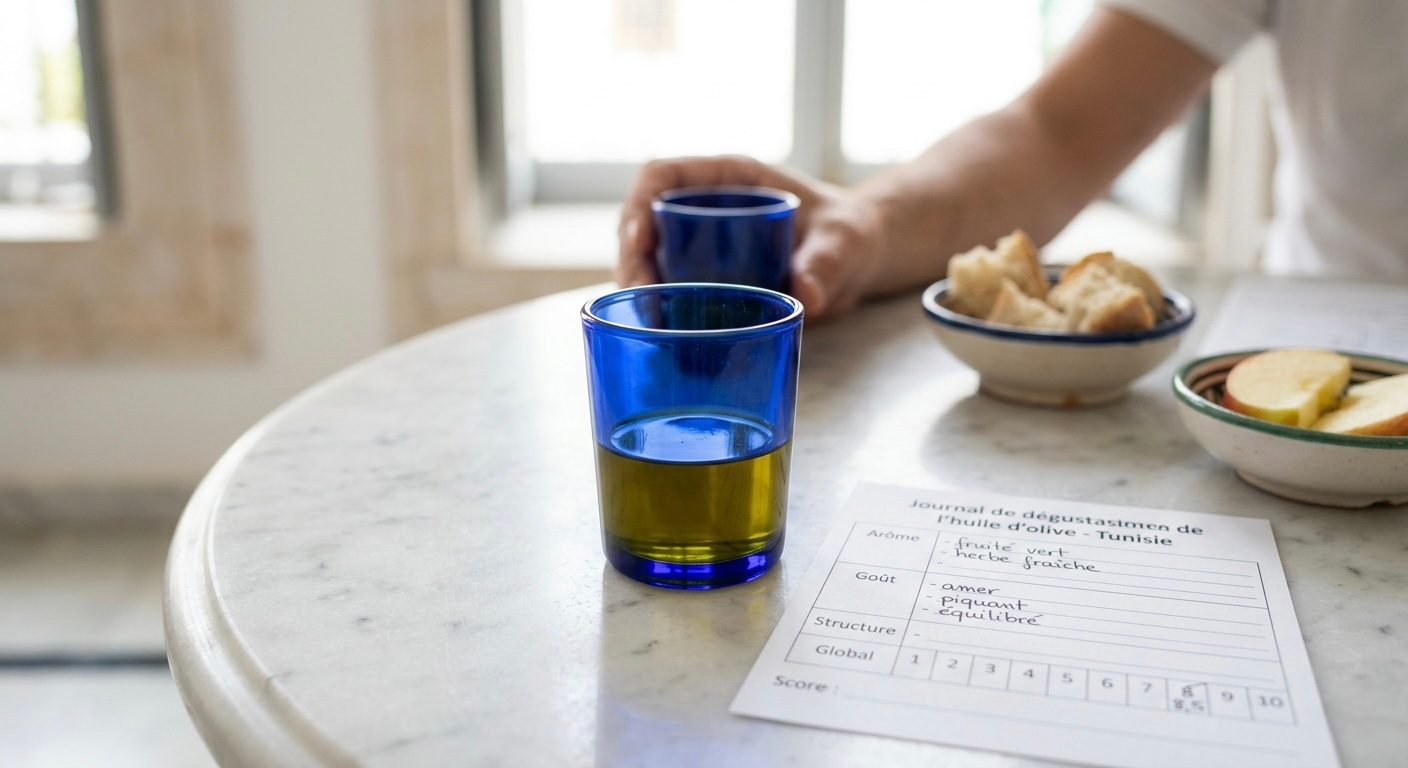
Ancient groves, exceptional climate, and a harvest tradition that predates most European records. Provenance in olive oil is not a romantic claim — it is a set of measurable conditions: variety, climate, soil, elevation, harvest timing. Tunisia scores well on every one of them.
Scale and Density
Tunisia has more olive trees per capita than almost any country on earth. Over 100 million trees spread across approximately 1.7 million hectares make the olive not merely an agricultural product here but an organising principle of the landscape. In the south, groves extend to the edge of the Sahara. In the centre and east, they form a continuous textile across the limestone plains. This is not monoculture imposed by agribusiness. It is the accumulated result of three thousand years of cultivation decisions made by people who understood the land they were working.
The scale matters because it speaks to adaptation. When a variety has been planted, selected, replanted, and adapted in one place across dozens of generations of farmers, what survives is not an accident. It is a refinement. The trees that remain are those that suited the soil, the water table, the summer heat, the occasional frost. They are, in a meaningful sense, the product of the region as much as the region is shaped by them.
Sfax: The Centre of Gravity
The Sfax region sits at the heart of Tunisian olive culture. The groves that surround this eastern coastal city are some of the oldest continuously cultivated agricultural land in the world. Among them, individual trees documented at over 1,500 years old still produce fruit. These are not museum pieces — they are working trees, harvested each season, pressed, and consumed. The continuity is unbroken.
This is worth pausing on. In Europe, the oldest reliably documented olive cultivation dates to roughly the same period as the Roman Empire's expansion into the Mediterranean basin. In Tunisia, the olive preceded Rome. The groves of Sfax were old when the Colosseum was being built. The tradition that informed the agriculture, the pressing methods, and the culinary use of olive oil in this region does not derive from any European influence — the influence, where it existed, ran in the other direction.
The Chemlali Variety
Chemlali is native to Tunisia and particularly dominant in the Sfax region. It is not a variety that was bred for convenience or yield. It is a variety shaped by centuries of natural selection in conditions that offered neither. Chemlali is drought-resistant to a degree that would be remarkable in any crop — the root systems run deep, the canopy is sparse and efficient, and the tree conserves water with the economy of something that has never been able to rely on rain arriving when expected. The result is a fruit under productive stress, and productive stress in olives is a quality indicator.
Stressed olives concentrate their resources. The polyphenol content of Chemlali oil is consistently high — these compounds function as the tree's defence mechanism against UV radiation, drought, and oxidative damage. When we press them out, we carry those defences with us. The flavour profile of Chemlali is robust: green and precise, with pronounced bitterness and a pungency that persists in the throat. It is not a gentle variety. It was not shaped by gentle conditions.
concentrates everything that matters.
Climate and Diurnal Swing
Tunisia's climate is Mediterranean along the coast but becomes more continental as you move inland — where many of the highest-quality groves are situated. Long, dry summers and mild, wet winters define the growing season. But the detail that most directly affects oil quality is the diurnal temperature swing during harvest season: the difference between daytime and overnight temperatures in late October and November can exceed fifteen degrees Celsius.
This swing concentrates polyphenols in the fruit. Warm days push metabolic activity; cool nights slow it. The olive accumulates phenolic compounds as part of its stress response to these oscillations, and the compounds that accumulate are precisely those responsible for the bitterness, pungency, and antioxidant stability that distinguish high-quality extra virgin oil. The climate is not incidental to what ends up in the bottle. It is a direct contributor to the chemistry of the oil.
Soil: The Value of Poor Ground
The soils around Sfax are largely calcareous — limestone-based, alkaline, well-draining, and poor in organic matter. By the standards of most agriculture, these are difficult soils. They hold little water and offer limited nutrition. For olive cultivation, this is the point. An olive tree in rich, well-watered soil produces abundant fruit with diluted character. An olive tree in poor, dry, stony ground produces less fruit, but what it produces is more concentrated, more complex, and more interesting. The soil is not a constraint to be overcome. It is a condition to be worked with.
Harvest Timing: Earlier Than Europe
Tunisia harvests earlier than Spain or Italy — late October into November, when polyphenol content in the fruit peaks before full ripeness reduces it. The biochemistry is straightforward: as the olive ripens toward full black, its polyphenol content falls and its oil content rises. Harvesting early trades volume for quality. The oil yield per tonne of fruit is lower. The polyphenol concentration per litre of oil is higher. It is a decision that costs money at every stage — more labour per litre extracted, lower overall yield — and produces a measurably superior result.
This timing advantage is partly structural. Tunisia's earlier harvest season, driven by its latitude and climate, means polyphenol peaks arrive before the cold that can complicate harvest logistics further north. The calendar works in Tunisia's favour. Producers who understand this use the window with discipline.
History Without Romance
The Phoenicians brought olive cultivation to North Africa before Rome's rise as a Mediterranean power. Roman mosaics excavated across modern Tunisia — including the extraordinary collection at the Bardo National Museum in Tunis — depict olive harvests in detail: ladders, baskets, the arrangement of workers, the pressing equipment. The images are precise enough to confirm that the fundamental method of harvest has changed less than almost any other agricultural practice over two millennia. The olive was not imported here and adapted. It was cultivated here, refined here, and exported from here to the tables of an empire.
None of this history improves the oil by itself. What it confirms is that the knowledge of how to manage these trees, this soil, and this climate has had an unusually long time to develop. Tradition is not nostalgia — it is accumulated technical knowledge, tested and corrected over generations. In olive cultivation, that matters.
What This Means for AL WASAT
We source from this region because provenance is not marketing copy — it is measurable. Higher polyphenols, lower acidity, earlier harvest, native drought-resistant variety on limestone soil with Mediterranean-continental climate oscillations. These are not attributes we have invented or selected for the label. They are the conditions of the place. Our role is to not ruin what the grove has already produced: harvest at the right moment, mill within hours, extract cold, bottle in dark glass, and test every batch independently.
The numbers are on the label because they should be. Polyphenol content, acidity, harvest date — these are the coordinates of quality. Anyone who tells you provenance is a feeling rather than a fact has not read the analysis sheets. We have. Tunisia earns its place at the top of this category. AL WASAT is our argument that it belongs there.