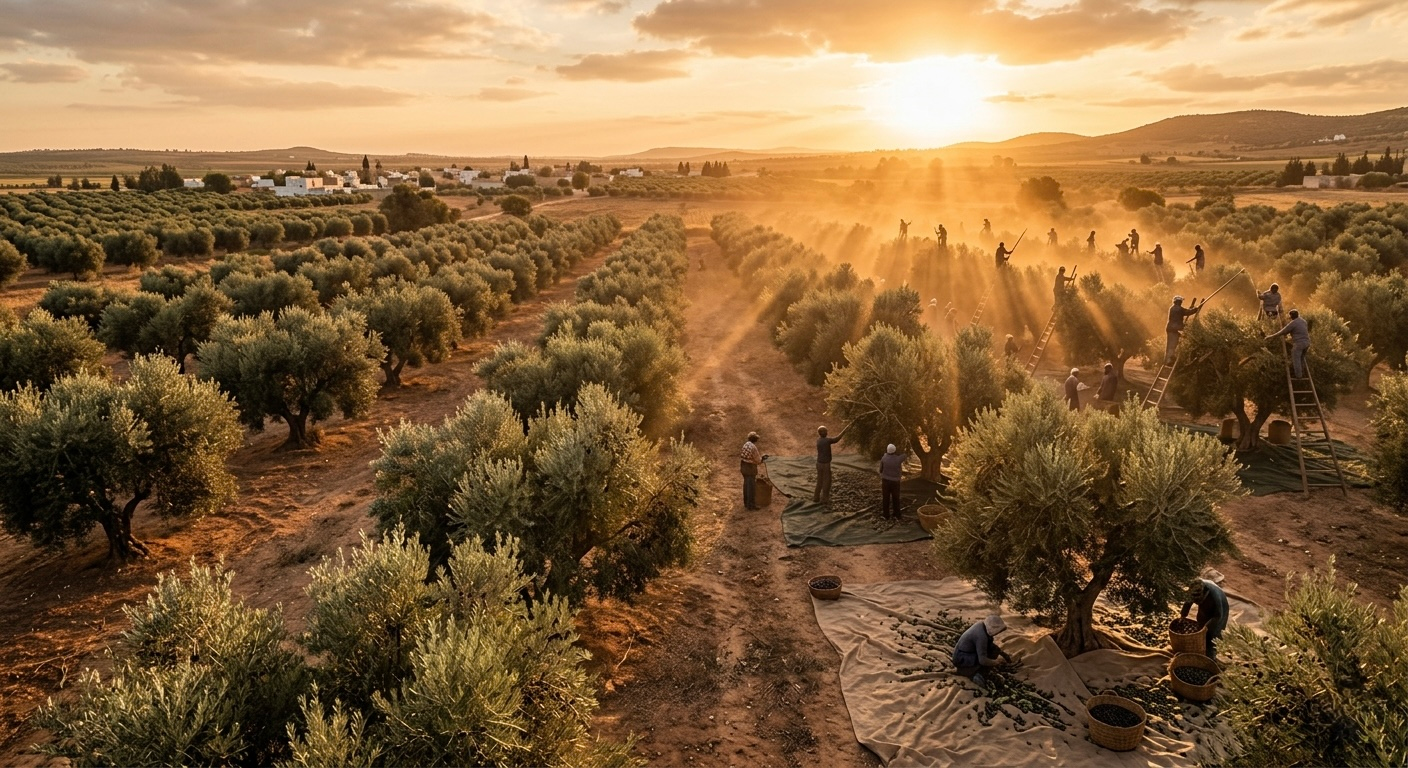
Every harvest is a negotiation between what the land offers and what the grower is willing to accept. The 2024 season in Tunisia's Sfax region yielded something rarer than quantity: oil of exceptional polyphenol density, pressed from fruit harvested weeks ahead of conventional timing, under conditions that rewarded patience and precision in equal measure.
The Weather in Sfax
The 2024 growing season opened with a dry, cool spring — the kind that concentrates the vine but stresses the unprepared grower. Rainfall through March and April was below the ten-year average for the Sfax region, prompting early attention to soil moisture and irrigation scheduling. Then, through June and July, temperatures climbed steadily, with several periods of sustained heat that pushed the fruit to mature faster than usual.
This compression of the growing calendar is not inherently bad. Stress, applied with care, can sharpen an olive. The reduced water availability encouraged the tree to draw down reserves, producing smaller fruit with proportionally more solid matter — and in extra virgin olive oil, the polyphenols reside in the olive's vegetation water and solid fractions. Stress, here, is a mechanism of concentration.
By September, the groves carried fruit that was physiologically mature but not phenologically late. The visual cues were consistent: tight skin, deep green-to-turning colour, a waxy sheen that under the Sfax light reads almost silver. The decision to harvest was not obvious. Conventional timing in the region runs into October. We moved earlier.
The Early Harvest Decision
Harvest timing is the most consequential decision in olive oil production. It cannot be undone. Pick too late and the oil softens, polyphenols fall, and the aromatic profile dulls toward the generic. Pick too early and you risk bitterness that dominates rather than balances, and yields that do not justify the effort. The window of peak quality is narrow and shifts year to year.
is narrow and shifts year to year.
For the 2024 batch, our agronomists made the call on September 19th, citing three convergent signals: polyphenol modelling based on tissue samples, the maturity index of representative trees across three blocks, and a weather forecast showing a warm spell arriving in early October that would accelerate senescence beyond the useful range. The harvest proceeded over five days, with daily milling to minimise time between picking and pressing.
The result is oil with a free acidity below 0.2%, peroxide values well within extra virgin grade, and polyphenol content that laboratory analysis placed in the top tier for the region and vintage. These are not marketing numbers. They are the direct consequence of a decision made under uncertainty, guided by data and confirmed by outcome.
What Makes This Batch Distinct
The 2024 AL WASAT oil carries a profile that is immediately legible. The colour is a deep, luminous green at bottling, moving toward gold-green as it settles. The nose is precise: cut green herbs, artichoke, fresh almond skin, with a secondary note of green tomato that appears when the oil is warmed slightly in the glass. The taste opens clean, builds to a structured bitterness at mid-palate, and finishes with the prolonged peppery sensation — felt in the throat — that is the hallmark of high polyphenol content.
This batch is not a soft oil. It is not designed for those who prefer neutrality. It is designed for those who want olive oil to taste like what it is: a fresh-pressed fruit juice with genuine complexity, structural tension, and a provenance that can be traced to a specific harvest window in a specific region during a specific year.
We bottled the 2024 harvest in October and November, under nitrogen atmosphere to prevent oxidation. Each bottle carries the harvest date and batch number. The quantity is limited by what the groves produced — approximately 2,400 litres from the September harvest block. When it is gone, it is gone. The 2025 season will be its own negotiation.