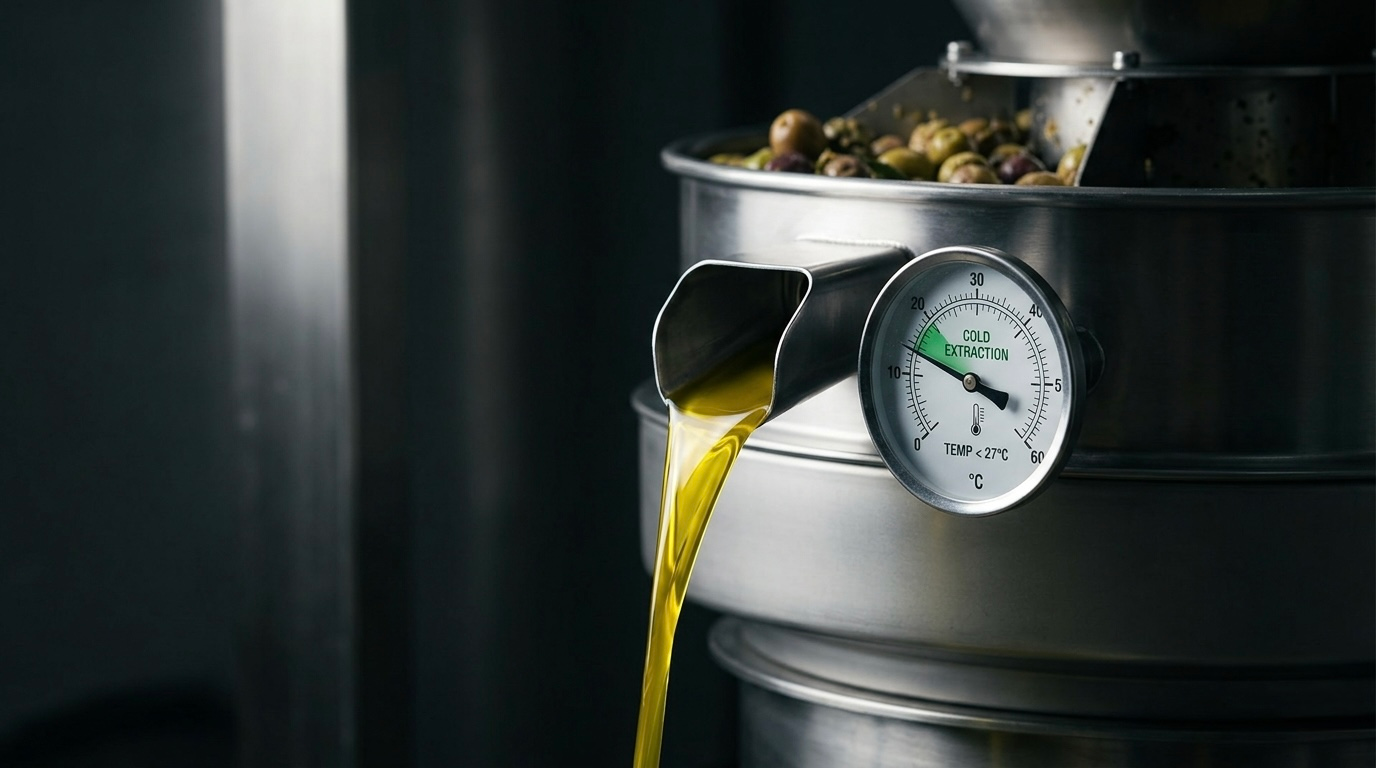
Cold extraction is one of those phrases that has travelled faster than its explanation. It appears on bottles, menus, tasting notes, and handsome labels, often doing the work of a certificate without the discipline of one. In olive oil, however, the term has a precise meaning: the oil has been obtained only by mechanical means, with the olive paste and oil kept below 27°C during extraction.
Below 27°C
The route from fruit to oil is direct, but not simple. Olives are washed, crushed into a paste, slowly mixed, and separated by centrifuge into oil, vegetation water, and solids. During malaxation, the slow mixing stage, microscopic droplets gather into larger ones. It is here that temperature matters most. Warm paste gives more easily. It flows faster, releases more oil, and flatters the spreadsheet. It can also remove the qualities that make extra virgin olive oil worth seeking.
Olive oil is not an inert fat. It carries a consequential architecture of polyphenols, pigments, tocopherols, and volatile aroma compounds. Polyphenols contribute bitterness, pepper, antioxidant stability, and much of the oil's nutritional interest. Volatiles carry the impressions we recognise before we name them: cut grass, almond skin, tomato leaf, green banana, artichoke, herbs after rain. These compounds are fragile. Excess heat can mute them, pushing an oil toward softness, sameness, and a shorter life in the bottle.
The 27°C threshold is not theatre. It is the conventional boundary used for cold extraction claims in extra virgin production. A serious mill does not treat it as a marketing line, but as a ceiling. The better question is not whether the producer can print the words; it is whether the process has been managed so that the olive never has to surrender freshness for yield.
It rarely improves character.
What Heat Changes
Temperature affects both chemistry and style. Higher temperatures can accelerate oxidation, reduce phenolic intensity, and diminish the volatile compounds that give a fresh oil its lift. The change is not always dramatic. A warmer-extracted oil may still be clear, golden, and agreeable. But it will usually have less tension: less bitterness at the edge of the tongue, less pepper in the throat, less green precision in the aroma. Luxury, here, is often a question of what has not been lost.
This is also where cold-extracted extra virgin olive oil parts company with refined oil. Refined oils are made from oils that require correction. Heat, filtration, deodorisation, neutralisation, and other treatments can remove defects and produce a stable, pale, mild fat. Useful, certainly. Anonymous, often. Refining solves a problem by removing evidence. Extra virgin olive oil has no such second act. It must be sound at the start, because quality is built in the grove and protected at the mill.
Time at the Mill
For AL WASAT, established in Tunisia in 1960, cold extraction begins before the olives reach the crusher. Fruit is harvested with attention to ripeness, bruising, transport, and time. Once picked, olives are living material under pressure. Skins break. Enzymes start working. Heat builds in crates. Oxidation and fermentation do not wait.
That is why AL WASAT mills within hours of harvest. Speed is not a boast; it is a control measure. Shortening the interval between tree and extraction preserves the cleanest aromatics, limits degradation, and gives the miller better fruit. From there, temperature is kept below 27°C through the extraction cycle, allowing the oil to express the season without the coarse intervention of heat. The result is not louder oil. It is more exact oil: structured, green, peppered, and legible.
Tunisia's olive culture is old enough to make romance easy. AL WASAT prefers the practical view. The work is picking at the right moment, moving quickly, milling cool, storing properly, and accepting that a smaller yield can be the more serious choice. Craft is the quiet refusal to take more from the fruit than it is ready to give.